Is BMW Maintenance Expensive? Real Costs and Savings Explained
January 30 2026 - dave@phatoon.com
Let's get straight to the point. Is BMW maintenance expensive? The short answer is yes—owning a BMW typically costs more to maintain than your average car. But that premium price tag is tied directly to the performance and precision engineering that define the brand.
 When you buy a BMW, you’re investing in an expertly crafted machine designed for an exceptional driving experience. That level of engineering requires specialized parts, fluids, and technicians, which naturally leads to higher service costs compared to mass-market vehicles.
Think of it like owning high-performance athlete's gear versus standard gym clothes. Both serve a purpose, but one is made with advanced materials and technology that demand specific care to maintain peak condition. The same logic applies to your BMW.
When you buy a BMW, you’re investing in an expertly crafted machine designed for an exceptional driving experience. That level of engineering requires specialized parts, fluids, and technicians, which naturally leads to higher service costs compared to mass-market vehicles.
Think of it like owning high-performance athlete's gear versus standard gym clothes. Both serve a purpose, but one is made with advanced materials and technology that demand specific care to maintain peak condition. The same logic applies to your BMW.
These figures highlight how costs tend to increase as the vehicle ages, which is typical for any car but more pronounced with performance luxury brands.
 As you can see, the biggest cost drivers are the specialized parts and the sophisticated engineering that makes a BMW feel like a BMW in the first place.
The numbers tell a clear story. BMW occupies a space where premium performance commands a premium price for upkeep. Understanding this context is the first step toward making an informed decision about ownership. It’s not just about the cost, but the incredible value you get for that cost every time you get behind the wheel.
 So, let's move away from long-term averages and step into the service bay. What can you actually expect to pay for the most common maintenance jobs? The best way to budget for ownership and avoid any nasty surprises is to understand the real-world costs of individual services. These numbers offer a transparent look at what it really takes to keep your BMW performing at its peak.
By breaking down these costs, we can pull back the curtain on the financial side of ownership. This lets you plan ahead intelligently and approach your maintenance schedule with confidence, fully prepared for what it takes to care for a high-performance machine.
So, let's move away from long-term averages and step into the service bay. What can you actually expect to pay for the most common maintenance jobs? The best way to budget for ownership and avoid any nasty surprises is to understand the real-world costs of individual services. These numbers offer a transparent look at what it really takes to keep your BMW performing at its peak.
By breaking down these costs, we can pull back the curtain on the financial side of ownership. This lets you plan ahead intelligently and approach your maintenance schedule with confidence, fully prepared for what it takes to care for a high-performance machine.
 Choosing where to get your BMW serviced is a decision that hits both your wallet and your car’s long-term health. While independent shops might flash a lower hourly rate, a certified dealership like Habberstad BMW of Huntington delivers a completely different kind of value, one built on expertise, precision, and a commitment to preserving the very performance you fell in love with.
Think of it this way: you wouldn't ask your family doctor to perform specialized heart surgery. The same logic applies to your BMW. Our certified service centers are staffed by factory-trained technicians who live and breathe these complex machines every single day.
They know the specific quirks of each model and have access to proprietary diagnostic equipment that can sniff out issues with an accuracy that general-purpose tools simply can't touch.
Choosing where to get your BMW serviced is a decision that hits both your wallet and your car’s long-term health. While independent shops might flash a lower hourly rate, a certified dealership like Habberstad BMW of Huntington delivers a completely different kind of value, one built on expertise, precision, and a commitment to preserving the very performance you fell in love with.
Think of it this way: you wouldn't ask your family doctor to perform specialized heart surgery. The same logic applies to your BMW. Our certified service centers are staffed by factory-trained technicians who live and breathe these complex machines every single day.
They know the specific quirks of each model and have access to proprietary diagnostic equipment that can sniff out issues with an accuracy that general-purpose tools simply can't touch.
At Habberstad BMW of Huntington, our certified technicians are dedicated to providing the expert care your vehicle deserves. Whether you have more questions or are ready for your next service, we are here to ensure your BMW delivers the performance you love for years to come. Schedule your next service appointment with us online today.
The Real Cost of Owning a BMW
When you buy a BMW, you’re investing in an expertly crafted machine designed for an exceptional driving experience. That level of engineering requires specialized parts, fluids, and technicians, which naturally leads to higher service costs compared to mass-market vehicles.
Think of it like owning high-performance athlete's gear versus standard gym clothes. Both serve a purpose, but one is made with advanced materials and technology that demand specific care to maintain peak condition. The same logic applies to your BMW.
What the Data Shows
To get a realistic picture of ownership, it helps to look at the numbers over the long term. Major publications often analyze owner-reported data to quantify these expenses, giving us a clear benchmark. According to a detailed Consumer Reports study based on owner surveys, BMW ranks among the most expensive luxury brands to maintain. Their research found that in the first five years of ownership, BMW owners can expect to spend an average of $1,700 on maintenance. Over the next five years, those costs can jump to $7,800, bringing the total for a decade to a hefty $9,500. You can read the full research about these ownership costs for more details. To make it easier to see how those costs break down, here's a quick look at the average maintenance expenses over a 10-year period.BMW Maintenance Costs At a Glance
| Ownership Period | Average Maintenance Cost |
|---|---|
| Years 1-5 | $1,700 |
| Years 6-10 | $7,800 |
| 10-Year Total | $9,500 |
Owning a BMW means budgeting for more than just the monthly payment. Factoring in routine maintenance and potential repairs from the start is the key to a stress-free ownership experience.This financial commitment is the trade-off for the unparalleled performance and driving dynamics that BMWs offer. The key is to be informed and prepared. The following sections will break down exactly why these costs are higher, how they compare to other brands, and what you can do to manage them effectively.
Why You Pay a Premium for BMW Service
Ever get the bill for a routine oil change on your BMW and wonder why it’s a bit steeper than what your friend pays for their family sedan? It’s a fair question, and the answer isn’t just about the iconic blue and white roundel on the hood. The premium you pay is a direct reflection of the sophisticated engineering, specialized components, and expert knowledge required to keep these performance machines running exactly as their designers intended. When you invest in a BMW, you’re not just buying a car; you’re buying a piece of high-performance engineering. This isn't just marketing fluff, it translates into real-world hardware. For instance, BMW’s brilliant VANOS variable valve timing system, designed for optimal power and efficiency, needs precise calibration and high-quality synthetic oils to do its job. That complexity demands a higher level of service expertise than a standard engine.Advanced Engineering and Materials
BMWs are built with an obsessive focus on the driving experience, which often means using lightweight materials like aluminum and magnesium in the chassis and suspension. These materials are fantastic for improving handling and fuel economy, but they also require specialized tools and very specific techniques for any repair work. The engines themselves are just as intricate. Think of it like comparing a gourmet meal crafted by a master chef to a simple sandwich. Both will satisfy your hunger, but one uses higher-quality ingredients and a complex recipe that requires a skilled hand. Servicing a BMW engine properly means understanding its unique needs, which is a world away from what a general-purpose auto shop is equipped to handle.I had a small oil leak in my 5 Series. The independent shop quoted me a price, but my gut told me to go to the dealer. The BMW tech found it was a specific gasket common to that engine that the other shop missed. It cost a bit more upfront but saved me a potential engine disaster. — An owner's comment found on a BimmerFest forum
The Role of Genuine OEM Parts
Another major piece of the cost puzzle is the use of Original Equipment Manufacturer (OEM) parts. These are the very same components your BMW was assembled with at the factory. Using genuine parts is the only way to guarantee a perfect fit, peak performance, and long-term durability, which is critical for maintaining your vehicle’s safety and engineering integrity. Sure, you can save a few bucks with cheaper aftermarket parts, but it’s a huge gamble. They often don't meet BMW's incredibly strict tolerances, which can lead to premature failure or, even worse, cause damage to other connected systems. This can quickly turn a small, inexpensive repair into a massive, costly headache. It’s the classic case of paying a little more now to avoid paying a lot more later.Specialized Technicians and Tools
Finally, a big part of what you're paying for is the technician's brain. BMW-certified technicians go through continuous, rigorous training directly from the manufacturer. They live and breathe these cars, learning the specific nuances of every single model and having access to proprietary diagnostic tools and software that generic shops simply don't have. This specialized equipment allows them to diagnose issues with surgical precision, whether it's a mysterious check engine light or a complex electronic fault. That accuracy ensures problems are fixed correctly the first time, saving you from the frustrating and expensive cycle of trial-and-error repairs. Ultimately, paying a premium for BMW service isn't about the logo; it's about preserving the incredible performance and engineering you paid for in the first place.How BMW Maintenance Costs Stack Up Against Other Brands
To really get a feel for whether BMW maintenance is "expensive," you need some context. After all, the cost is relative. Putting BMW head-to-head with other brands, from its German luxury rivals to everyday commuter cars, shows you exactly where it fits in the automotive landscape. Let's be upfront: maintaining a BMW will cost more than a non-luxury car like a Honda or a Toyota. That's to be expected. Those cars are engineered for mass-market simplicity and reliability, which naturally keeps parts and labor costs down. A BMW is a different animal, built for a dynamic driving experience that demands more advanced and therefore more expensive components and specialized care. But how does it fare against its direct competitors in the luxury arena?The Luxury Brand Showdown
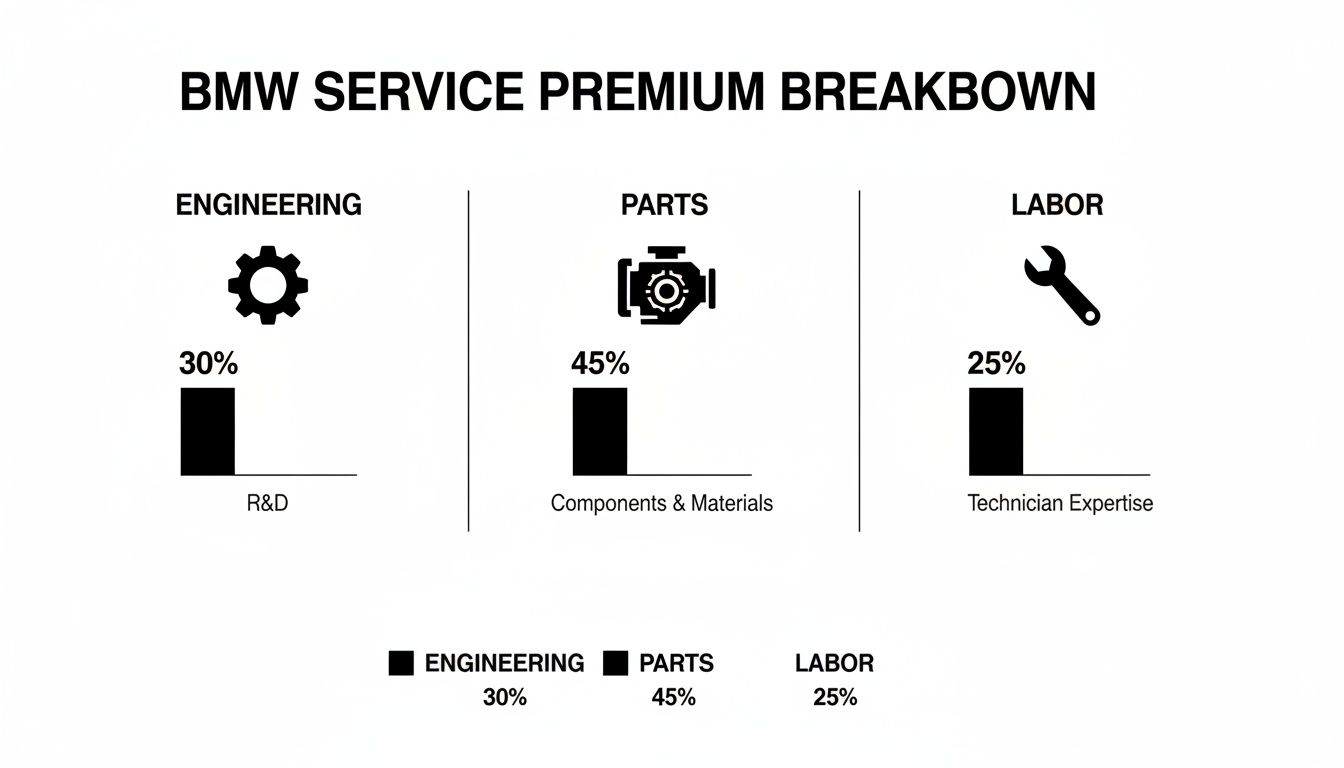
When you line BMW up against other premium German brands like Audi and Mercedes-Benz, the costs start to look much more similar. These manufacturers all share a philosophy of complex, performance-focused engineering and high-quality materials. It makes sense, then, that their long-term maintenance bills often land in the same ballpark. Still, the data reveals some clear differences. A deep-dive analysis by CarEdge ranks luxury brands by their estimated 10-year maintenance costs. In this breakdown, BMW lands at number 13 with a projected cost of $16,021 over a decade. That puts it just behind Land Rover ($18,072) but significantly higher than famously reliable brands like Lexus ($7,110) or the all-electric Tesla ($4,281). You can dig into the complete luxury car maintenance rankings on CarEdge.com. This information confirms that while BMW is definitely on the higher end, it’s not an outlier; it sits right within a competitive pack of performance-driven European marques. The chart below gives a great visual of where the money goes when you service a BMW, breaking down the premium you pay into engineering, parts, and labor.
As you can see, the biggest cost drivers are the specialized parts and the sophisticated engineering that makes a BMW feel like a BMW in the first place.
The Trade-Off: Balancing Cost with Performance
So, is BMW maintenance expensive compared to its rivals? Yes, especially when you compare it to a brand like Lexus, which prioritizes reliability above all else. But that comparison misses the whole point. You don't choose a BMW for the numbers on a maintenance spreadsheet. You choose it for the experience.One owner on Reddit summed it up perfectly: "You don't buy a BMW to save money... You buy it for the driving dynamics and the feeling you get behind the wheel. The maintenance is just the price of admission for that experience."When you factor in the incredible handling, the responsive power, and the precision engineering you get with every BMW, the costs start to make a lot more sense. For many owners, it's a trade-off they're happy to make. To put all this data into perspective, here’s a table comparing the average 10-year maintenance costs for BMW against some key competitors.
10-Year Maintenance Cost Comparison Luxury vs Non-Luxury
| Brand | Average 10-Year Maintenance Cost | Category |
|---|---|---|
| Toyota | $5,572 | Non-Luxury |
| Honda | $6,738 | Non-Luxury |
| Lexus | $7,110 | Luxury |
| Audi | $12,084 | Luxury |
| Mercedes-Benz | $13,446 | Luxury |
| BMW | $16,021 | Luxury |
A Practical Look at Common BMW Service Costs
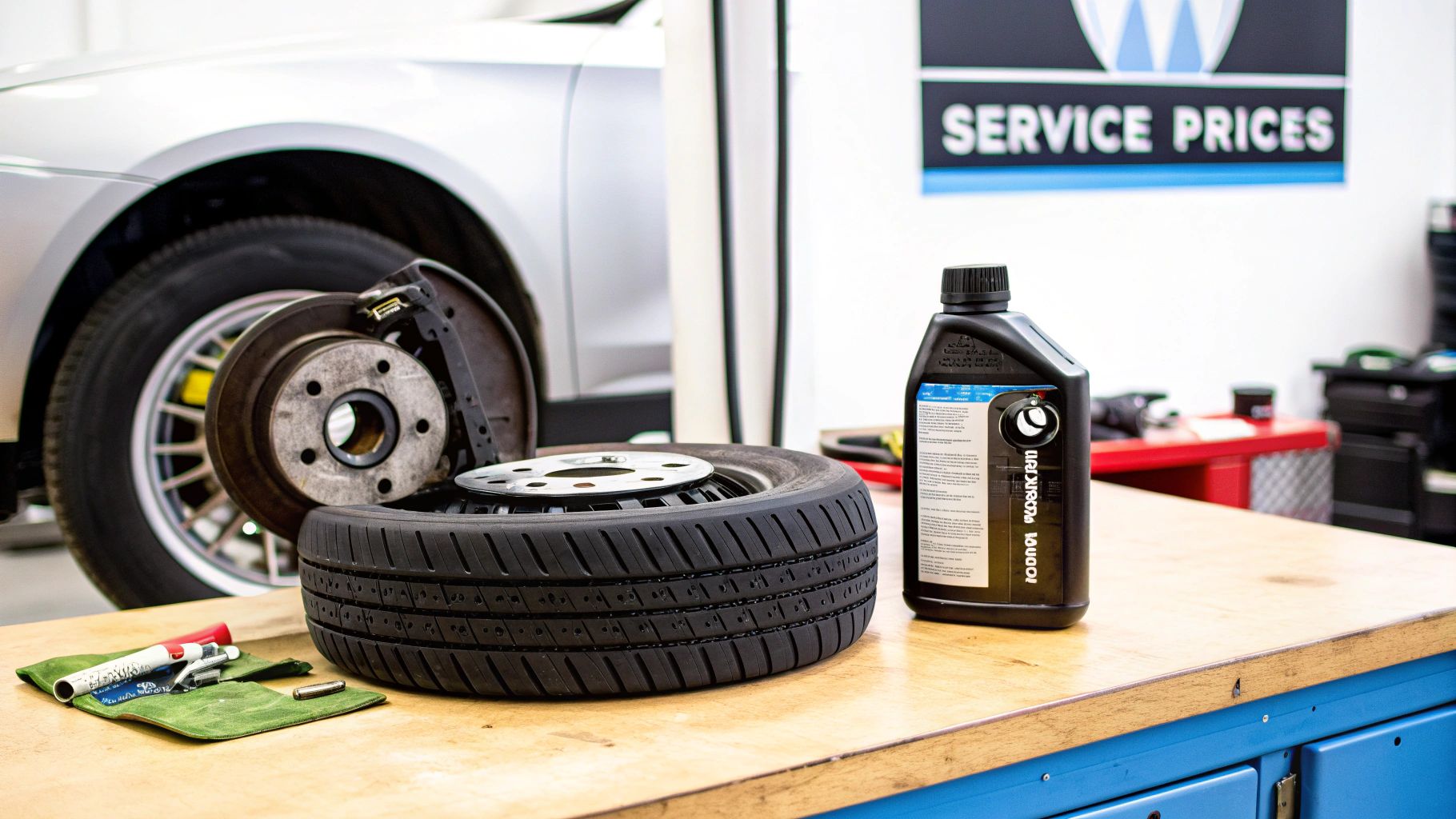
So, let's move away from long-term averages and step into the service bay. What can you actually expect to pay for the most common maintenance jobs? The best way to budget for ownership and avoid any nasty surprises is to understand the real-world costs of individual services. These numbers offer a transparent look at what it really takes to keep your BMW performing at its peak.
By breaking down these costs, we can pull back the curtain on the financial side of ownership. This lets you plan ahead intelligently and approach your maintenance schedule with confidence, fully prepared for what it takes to care for a high-performance machine.
Routine Maintenance Essentials
First things first, let's cover the basics. These are the regular services every single BMW needs to ensure its performance and longevity. While prices will definitely shift based on your specific model and where you're located, these ranges give you a solid baseline to work from.- Full Synthetic Oil Change: Plan on spending between $150 and $250. BMWs demand high-quality synthetic oil and specific filters to protect their finely tuned engines, which is why this service costs more than a conventional oil change on a non-luxury car.
- Brake Pad and Rotor Replacement: This is a safety-critical job you can't put off. Replacing the pads and rotors on just one axle (front or rear) will typically cost between $600 and $1,000. That price reflects the premium, OEM-grade parts designed for superior stopping power that you really want on a performance vehicle.
One BMW owner on an enthusiast forum put it perfectly: "The dealership quoted me about $800 for my rear brakes and rotors on my 330i. It seems high until you realize they're using OEM parts that last and perform way better than the cheap stuff."
Addressing More Significant Repairs
As your BMW gets older and racks up the miles, some components will inevitably wear out and need to be replaced. These repairs are less frequent, but they definitely carry a higher price tag. Knowing what they are is key to long-term financial planning, especially if you own a vehicle that's out of its warranty period. When you zoom out and look at the broader 10-year ownership costs, one analysis puts total BMW maintenance at $19,312. That number factors in everything from routine brake jobs to more complex fixes. For instance, a high-pressure fuel pump failure, which can be an issue in some models, might cost you $1,500 to $2,500 at an independent shop, and even more if you go to a dealer for genuine parts. You can discover more insights about these comprehensive maintenance estimates to get a fuller picture. Here are a few other significant repairs you should anticipate down the road:- Water Pump Replacement: This is a critical part of the cooling system. Replacing a failing water pump can range anywhere from $800 to $1,500.
- Valve Cover Gasket Replacement: Oil leaks are a classic sign of an aging engine. Fixing a leaky valve cover gasket usually runs between $500 and $900.
- Run-Flat Tires: A lot of new BMWs come with run-flat tires. While convenient, they can be 25% to 50% more expensive than standard tires, adding a significant bump to your replacement costs.
Smart Strategies to Lower Your BMW Maintenance Bills
While it's true that keeping a BMW in top shape can be more expensive than a non-luxury car, those costs aren't set in stone. Far from it. Smart, engaged ownership is your best tool for managing and significantly reducing your expenses over the long haul. With the right approach, you can enjoy the thrill of driving a BMW without the stress of unpredictable repair bills. The single most effective strategy is simple: embrace proactive, preventative maintenance. Think of it as the difference between a routine health checkup and emergency surgery. Following your BMW’s recommended service schedule prevents small issues from snowballing into major, eye-wateringly expensive failures. An oil change is always cheaper than an engine repair.Leverage Warranties and Service Programs
For anyone buying a new BMW, the factory offers programs designed to manage your costs right from day one. BMW Ultimate Care is a perfect example, covering all your scheduled maintenance for the first three years or 36,000 miles. This takes care of essentials like oil changes, filter replacements, and brake fluid flushes at no additional cost to you. If you're looking at a pre-owned vehicle, the Certified Pre-Owned (CPO) warranty offers incredible peace of mind. These cars go through a rigorous inspection and come with warranty protection that shields you from the cost of unexpected repairs on major components. As a car gets older, this becomes a huge advantage.A BMW owner from a popular forum shared their experience: "My CPO warranty saved me over $3,000 when my iDrive screen went blank. I paid a small deductible, and that was it. I'd never own one of these out of warranty without a backup plan."
Simple Habits That Make a Big Difference
You don’t have to be a master mechanic to have a huge impact on your car's health. Small, consistent checks at home can slow down wear and tear, extending the life of your components and saving you real money over time.- Check Your Tire Pressure: Properly inflated tires wear more evenly, last longer, and even improve your fuel economy. It only takes a few minutes each month.
- Monitor Fluid Levels: Get in the habit of regularly checking your engine oil and coolant. Topping them off if they get low can prevent serious engine damage down the road.
- Keep It Clean: Washing your car, especially the undercarriage in the winter, is about more than just looks. It helps prevent rust and corrosion that can damage your frame and suspension components.
Getting Real Value from Certified BMW Service
Choosing where to get your BMW serviced is a decision that hits both your wallet and your car’s long-term health. While independent shops might flash a lower hourly rate, a certified dealership like Habberstad BMW of Huntington delivers a completely different kind of value, one built on expertise, precision, and a commitment to preserving the very performance you fell in love with.
Think of it this way: you wouldn't ask your family doctor to perform specialized heart surgery. The same logic applies to your BMW. Our certified service centers are staffed by factory-trained technicians who live and breathe these complex machines every single day.
They know the specific quirks of each model and have access to proprietary diagnostic equipment that can sniff out issues with an accuracy that general-purpose tools simply can't touch.
The Power of Precision and Genuine Parts
Using genuine BMW parts is another huge piece of the puzzle. These aren't just "good enough" replacements; they are engineered to the exact specifications of your vehicle, guaranteeing a perfect fit and optimal performance. This is what preserves your car's sophisticated safety systems, enhances its reliability, and helps lock in a higher resale value down the road.One owner on a popular Bimmer forum put it perfectly: "My indie shop couldn't figure out a persistent check engine light. Took it to the dealer, and their tech diagnosed a faulty sensor in 20 minutes with their specific software. It showed me the value of having the right tools for the job."
More Than Just a Repair
Beyond the technical mastery, certified service centers offer conveniences that save you time and strip away the usual stress of car maintenance.- Loaner Vehicles: We know your life doesn't stop just because your car is in the shop. Many dealerships provide a courtesy loaner vehicle so your daily routine isn't disrupted.
- Transparent Service Advising: You'll work with a dedicated service advisor who walks you through the necessary repairs, explains the costs clearly, and helps you prioritize the work. No surprises.
- Parts and Labor Warranty: The work we do and the genuine parts we use are often backed by a warranty, giving you that extra layer of confidence and peace of mind.
Answering Your Top Questions About BMW Maintenance
To wrap things up, let's tackle some of the most common questions we hear from both longtime owners and people just starting to think about putting a BMW in their driveway. Getting straight answers helps cut through the noise, giving you the clarity to make smart decisions about caring for your car.Are Older BMWs More Expensive to Maintain?
The short answer is yes, an older BMW that’s out of its factory warranty will almost always cost more to maintain than a new one. As a car racks up the miles, parts like suspension components, gaskets, and various electronic modules naturally wear out and are more likely to need replacement. A new vehicle has the huge advantage of its warranty and programs like BMW Ultimate Care, which covers all your scheduled maintenance for the first few years. Once a car is past that period, those costs shift to the owner. That said, a well-cared-for older BMW with a comprehensive service history can still be an incredibly rewarding and reliable machine.Is an Independent Shop Cheaper Than a Dealer?
While an independent shop might advertise a lower hourly labor rate, it's not always the cheaper route in the long run. The key difference is that a certified dealership like ours exclusively uses genuine OEM parts, the exact same components your car was built with, backed by their own warranty.One owner on a popular BMW forum shared his experience: "My indie mechanic was stumped by a weird electrical issue. The dealer's master tech found it was a known software glitch and fixed it in an hour. Paid a bit more for the diagnostic, but saved days of guesswork."Our technicians also live and breathe BMWs. They get continuous factory training and use the latest diagnostic software that many independent shops simply don't have access to. This expertise leads to faster, more accurate fixes, which means you avoid paying for trial-and-error repairs with aftermarket parts that could fail prematurely.
How Often Does a BMW Really Need an Oil Change?
Modern BMWs are smart. They use a Condition Based Service (CBS) system that actively monitors your driving habits to tell you exactly when an oil change is needed. For most drivers, this works out to be around every 10,000 miles or once a year. However, a lot of enthusiasts and expert technicians recommend shortening that interval. Changing the full synthetic oil and filter every 5,000 to 7,500 miles is a fantastic preventative measure, especially if you do a lot of short trips or city driving. Think of it as cheap insurance for your engine's long-term health.At Habberstad BMW of Huntington, our certified technicians are dedicated to providing the expert care your vehicle deserves. Whether you have more questions or are ready for your next service, we are here to ensure your BMW delivers the performance you love for years to come. Schedule your next service appointment with us online today.