Thinking about buying a used car without checking its history? That’s like buying a house without ever stepping inside for an inspection. To really know what you're getting into, you need two things: the car’s Vehicle Identification Number (VIN) and a report from a trusted service like CarFax or AutoCheck. This report is your window into the car's past, revealing everything from accidents and title issues to service records, giving you the upper hand in any negotiation.
Why a Vehicle History Check Is Your Most Powerful Tool
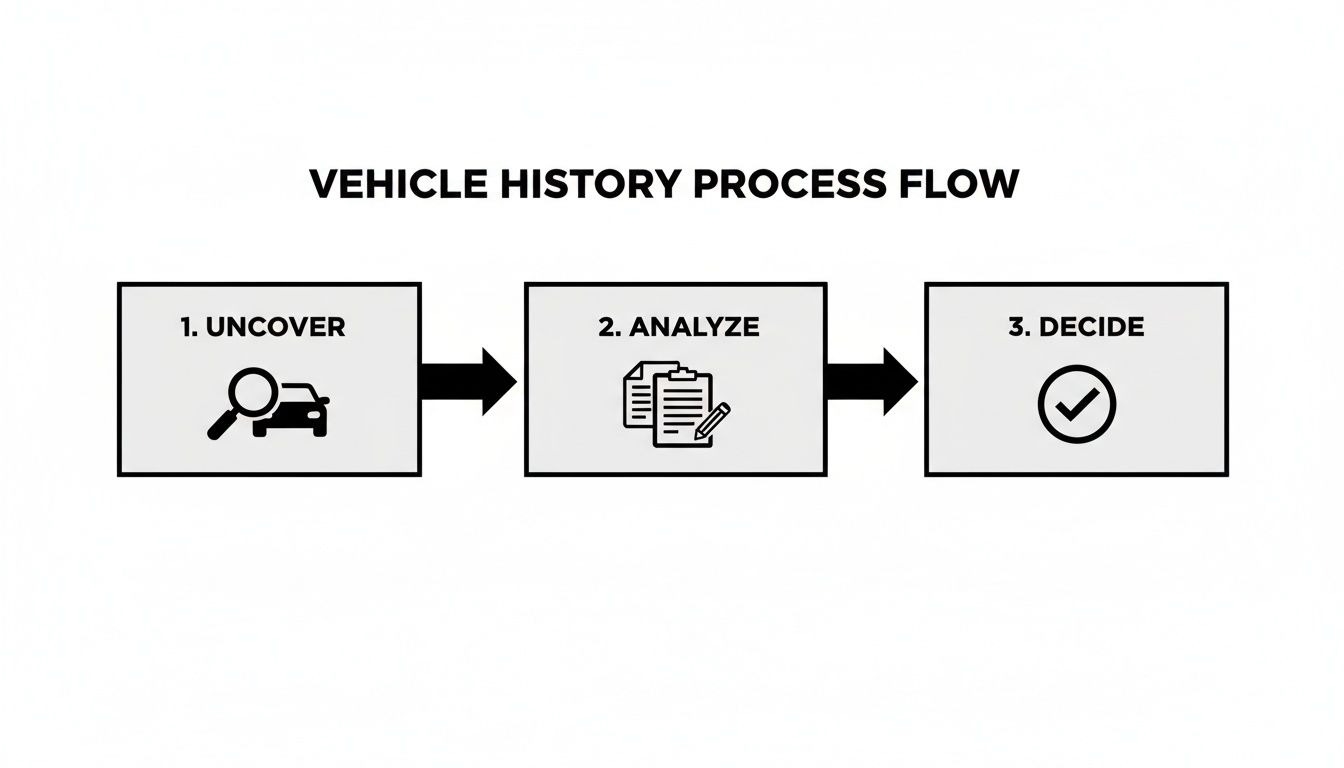
The used car market can feel like the Wild West, but it doesn't have to be. Your single best defense against a bad deal is a comprehensive vehicle history check. We're going to walk you through how to pull back the curtain on a car's past, from finding and decoding its VIN to digging into official records, so you can drive away with total confidence. The entire process boils down to three simple stages: uncover the facts, analyze what you find, and then make a smart decision. This workflow shows just how straightforward it is to move from gathering basic information to making a choice you won't regret. Each step empowers you a little more, turning abstract data into real knowledge that protects your wallet. Think of it as your first line of defense against hidden damage, odometer fraud, and sketchy titles.
The Real Cost of Skipping a Report
Forgoing a vehicle history report is a gamble, plain and simple. That shiny car in the driveway might have a salvage title from a few states over, meaning an insurance company once declared it a total loss. These cars often have deep-seated structural or electrical gremlins that are impossible to spot on a test drive. I saw this happen firsthand a few years ago. A friend found a screaming deal on a used SUV. It looked flawless and drove like a dream, so he skipped the $40 report to save a few bucks. Six months later, his mechanic found tell-tale signs of severe frame damage hidden by a fresh paint job. The car had been in a massive wreck. The repair bill was more than the car was worth.
A car shopper from San Diego shared their experience online: "I ran a CarFax and found out the car I was about to buy had its odometer rolled back by 50,000 miles. The report saved me from a massive headache and potentially thousands in engine repairs."
This guide is built on real-world experience, not just generic advice. A few minutes of research now can genuinely save you thousands of dollars and a world of hurt down the road.
What You Stand to Gain
A vehicle history check isn't just about dodging bad cars; it's also about validating the good ones. A clean report gives you incredible peace of mind and strengthens your negotiating power. When you can prove a car has a spotless record, you confirm its value and show the seller you're a serious, informed buyer. Specifically, a history check helps you:
- Verify Ownership: Confirm the person selling the car is the one on the title.
- Check Maintenance History: See if previous owners kept up with oil changes and factory-scheduled service.
- Spot Hidden Problems: Uncover red flags like flood damage, multiple accidents, or a history as a rental car.
In the end, this simple step is what ensures the car you bring home is safe, reliable, and worth the price you paid. It’s a non-negotiable for any smart car buyer.
Getting to Know the VIN: Your Car's DNA
Every car has a story, and the key to unlocking it is the Vehicle Identification Number (VIN). This isn't just a random string of digits; it’s a unique 17-character code that acts like the car's fingerprint. Think of it like a Social Security Number. It’s tied to that specific vehicle for life. Finding and verifying the VIN is the absolute first thing you should do. If you get this wrong, every report you pull will be useless because it'll be for a completely different car. It’s a simple check, but it's the bedrock of a smart car-buying decision.
Pinpointing the VIN on the Vehicle
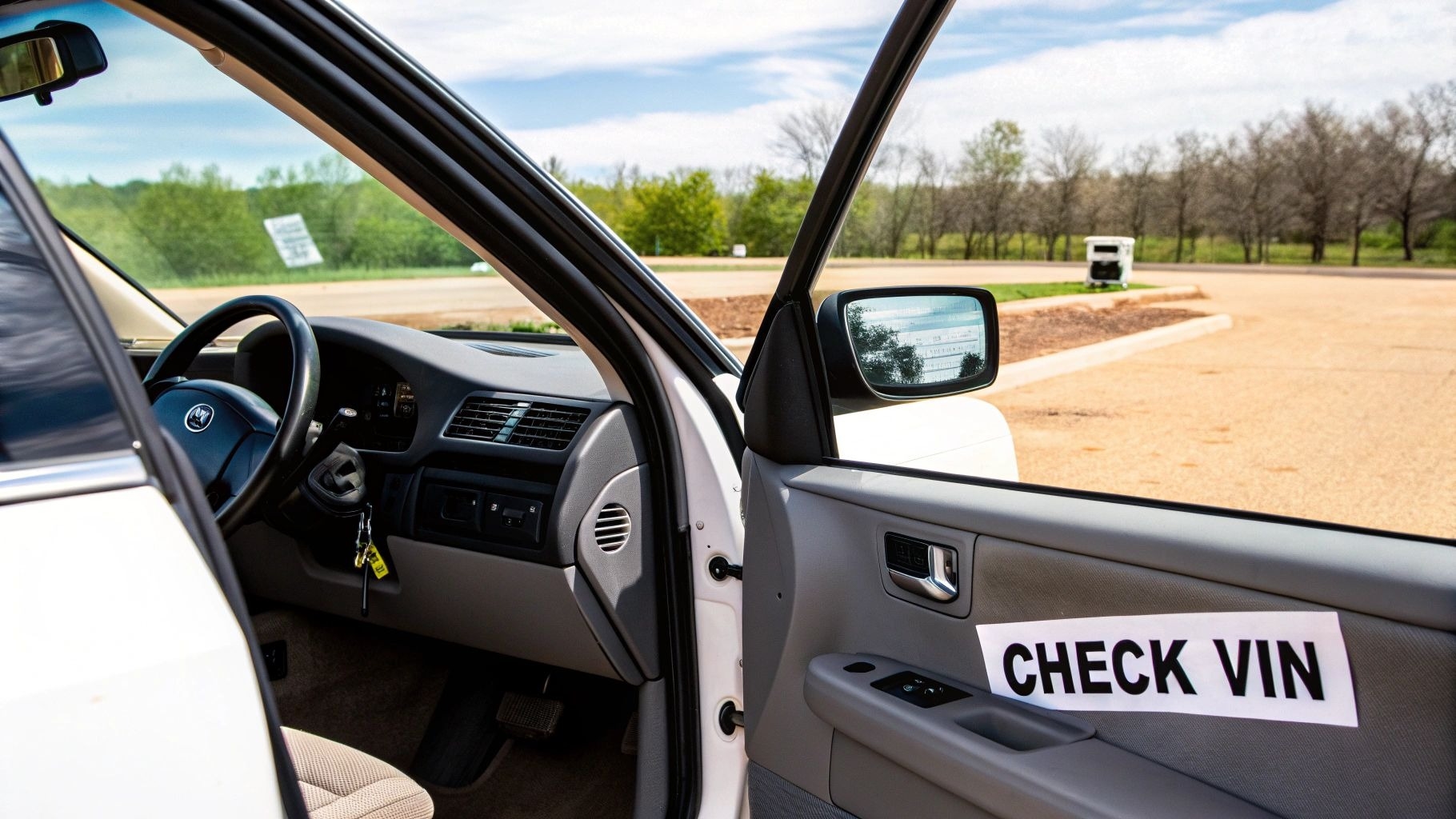
Car manufacturers are consistent about where they place the VIN, making it easy to find if you know where to look. Your job is to check these spots and make sure the VIN is identical in every single one. Any discrepancy is a deal-breaker. I’ve made it a personal rule to always cross-reference the VIN on the dash, the door jamb sticker, and the official title. I once walked away from a clean-looking sedan because the dashboard VIN didn't match the one on the title. The seller tried to brush it off as a clerical error, but that’s a risk you just don't take. Here’s a quick guide to help you find it.
Where to Find a Vehicle's VIN
| Location | What to Look For |
|---|---|
| Driver's Side Dashboard | A small metal plate visible through the windshield, right where the glass meets the dash. |
| Driver's Side Door Jamb | A sticker on the car's frame, usually visible when you open the driver's door. |
| Under the Hood | Stamped directly onto the engine block or on the firewall (the metal wall separating the engine from the cabin). |
| Vehicle Paperwork | The VIN is always listed on the title, registration documents, and insurance card. |
Checking these locations takes less than a minute but can save you from a massive headache down the road.
One car buyer on a popular forum shared this experience: "Was looking at a used truck and the VIN on the door sticker was scratched off. The seller said it 'rubbed off over time.' I checked the dash and it was there, but the damaged sticker was enough for me to pass. Too shady."
What That 17-Digit Code Actually Means
That long code isn't just gibberish; each character and section tells you something specific about the car. You don’t need to be a cryptographer, but knowing the basics can help you spot a fake VIN or a car that isn't what the seller claims it is. For instance, the 10th character always tells you the model year. If a seller says a car is a 2018 but the 10th digit is a 'J', you know something is wrong right away. Here's a simplified look at how to decode it:
- Characters 1-3: This is the World Manufacturer Identifier. It tells you the country of origin and the specific manufacturer (e.g., '1' for USA, 'J' for Japan).
- Characters 4-8: This section describes the vehicle's features, like its model, body style, and engine size.
- Character 9: This is a special "check digit," a security code calculated from the other characters to confirm the VIN is authentic.
- Character 10: The model year. It follows a standard pattern, like 'E' for 2014, 'F' for 2015, and so on.
- Character 11: The assembly plant where the car was built.
- Characters 12-17: The car's unique serial number, assigned as it came off the assembly line.
Once you’ve found the VIN in multiple places, confirmed they all match, and given it a quick once-over to ensure it makes sense, you're ready for the main event: pulling an official vehicle history report.
Choosing the Right Vehicle History Report Service
Once you have the VIN, you're ready to dig into the car's past. This is the moment you stop just looking at the paint and start reading the car's diary. But here’s the thing: not all vehicle history reports are created equal. They tap into different databases and present their findings in different ways, so picking the right one is key. Let's break down the big three: Carfax, AutoCheck, and the government-backed National Motor Vehicle Title Information System (NMVTIS). Each has its own strengths, and knowing which one to use can save you time, money, and a whole lot of headaches.
Carfax: The Data Powerhouse
Carfax is the household name in this space, and for good reason. They’ve built an absolutely massive network, pulling information from over 131,000 data sources. We're talking DMVs, insurance companies, repair shops, and dealerships. What I really value about Carfax is the level of detail it often provides on service and maintenance. A report showing consistent oil changes, tire rotations, and on-time major services is a huge green flag. It’s solid proof that a previous owner actually cared for the vehicle. On the flip side, long, unexplained gaps in service history should make you pause.
A buyer on an enthusiast forum shared a great story: "The Carfax showed the SUV I wanted had failed its emissions test twice before finally passing. The seller conveniently forgot to mention that, but the report gave me the leverage to ask about potential engine work and ultimately walk away."
Carfax often costs a bit more for a single report, but that detailed service history can be worth its weight in gold, especially when you're looking at a newer, more complex car where proper maintenance is non-negotiable.
AutoCheck: The Quick Comparison Tool
AutoCheck, which is owned by the credit agency Experian, is another heavy hitter. It draws from many of the same data sources as Carfax but has one standout feature I’ve found incredibly useful when I’m torn between two or three similar cars: the AutoCheck Score. This score, on a scale of 1 to 100, rates the vehicle and then shows you how it stacks up against other cars of the same make and model year. It’s a brilliant at-a-glance comparison. Seeing one Honda CR-V with a score of 92 and another with an 81 immediately tells you which one probably has a cleaner, less complicated past. AutoCheck also tends to be particularly strong with auction data. If a car has been sold at auction multiple times, it could mean it was a former rental or fleet vehicle, or maybe it had problems that dealers kept trying to offload. That's a piece of the puzzle you definitely want to have.
NMVTIS: The Budget-Friendly Title Checker
Now, the National Motor Vehicle Title Information System (NMVTIS) is a different beast entirely. It's not a private company; it’s a national database run by the U.S. Department of Justice to protect consumers from fraud. NMVTIS reports are designed to give you the most critical, high-level information for just a few dollars. They are laser-focused on a vehicle’s title history, making them an excellent first-pass screening tool.
- Title Brands: It will tell you if a vehicle has ever been branded as salvage, rebuilt, junk, or flood-damaged.
- Odometer Readings: You'll see the last known odometer reading that was reported to a state DMV.
- Total Loss History: It confirms if an insurance company has ever declared the vehicle a total loss.
You can find a list of approved report providers on the official government portal. Don’t expect a detailed list of oil changes or minor fender-benders here. That's not what NMVTIS is for. But as a fast, super-affordable way to rule out any major deal-breakers like a washed title, it’s unbeatable. Here's a pro tip: Start with a cheap NMVTIS report. If it comes back clean, then invest in a more comprehensive Carfax or AutoCheck report before you commit to buying. It's a smart, cost-effective way to get the full story.
Reading Between the Lines: How to Spot the Red Flags
Getting the vehicle history report is step one. The real work begins when you start digging into the details. A clean summary page doesn't always tell the whole story, so you need to know how to read between the lines and spot the warning signs that say, "walk away." Think of this as your first real inspection of the car. It’s where you can find the deal-breakers that could save you from a world of headaches and empty your wallet down the line.
Branded Titles: The Ultimate Deal-Breaker
The first thing I always scan for is a branded title. This is the big one. A branded title is a permanent stain on a vehicle's record, put there by an insurance company or a state DMV to signal a major problem. It means the car was once declared a total loss or has a severe, often unfixable, issue. Honestly, these are almost always non-negotiable. A car with a branded title is a gamble, and the odds are not in your favor. You're likely looking at persistent mechanical gremlins, hidden structural weaknesses, or electrical issues that even a top-notch mechanic can't fully sort out. Here are the brands you need to run from:
- Salvage Title: This is the classic. The vehicle was damaged so badly that the insurance company decided it would cost more to fix than it was worth. Even if it's been "rebuilt," you never know what corners were cut.
- Flood Damage: Water is a car's worst nightmare. It gets into everything, corroding wiring, ruining sensitive electronics, and leaving behind a musty smell and hidden mold. The real trouble with flood damage is that the problems can take months, or even years, to surface.
- Fire Damage: Much like flood damage, fire can wreak havoc. It compromises the vehicle’s structural integrity and melts the incredibly complex wiring harnesses, leading to endless, frustrating electrical problems.
- Lemon Law Buyback: This brand means the car had a serious manufacturing defect that the dealer just couldn't fix, even after multiple tries. The manufacturer had to buy it back from the original, frustrated owner. Do you want to be the next one?
I once saw a post on a car forum that stuck with me. A guy was excited about a 2-year-old sedan priced thousands below market value. He ran a Carfax report on a whim and discovered a 'Lemon Law' brand. It had a chronic transmission issue that three separate dealerships had failed to fix. That report saved him from inheriting a total nightmare.
Following the Odometer's Trail
Odometer fraud is one of the oldest scams in the used car game. A shady seller rolls back the mileage to make the car seem newer and less worn out, artificially inflating its price. A detailed history report is your best defense against this. You need to become a bit of a detective here. Scrutinize every single mileage entry on the report, from oil changes, state inspections, and title transfers. You're looking for a clean, logical progression. A sudden dip is a massive red flag. For example, if the car had 80,000 miles during a service in 2022 but magically shows 60,000 miles at its 2023 registration, you’ve almost certainly found a rollback. This isn't just a small-time issue. Odometer fraud is a huge problem globally. In Europe, where around 60 million used cars change hands each year, studies show 5-12% of domestically sold cars have had their odometers tampered with. It gets even worse for cars sold across borders, with a staggering 30-50% affected. As you can see from these automotive stats on OBDEleven.com, you have to be extra careful, especially with imported vehicles.
Decoding the Accident and Damage History
Look, most used cars have a little history. A parking lot scrape or a minor fender bender isn't necessarily a reason to panic. What you're really hunting for are signs of significant, repeated, or structural damage. The report won’t always flash a giant "MAJOR ACCIDENT" banner, so you have to connect the dots. Keep an eye out for these clues:
- Airbag Deployment: This is a dead giveaway of a serious collision. If an airbag went off, the impact was hard enough to absolutely require a thorough inspection by a professional you trust.
- Multiple Damage Reports: Seeing "damage reported" pop up several times, especially in a short period, is suspicious. It could point to one big accident that was reported in pieces or suggest the car is just a magnet for trouble.
- "Structural Damage" Mentions: Any note of "structural" or "frame" damage is a major cause for concern. This kind of damage can permanently affect how the car drives, handles, and protects you in another crash.
By carefully picking apart these three key areas, the title status, the mileage history, and the damage reports, you can weed out the problem cars before you ever waste your time on a test drive.
Get It Inspected: Why a Clean Report Isn't Enough
So you've pulled a vehicle history report, and it’s come back clean. That’s a great first step, but don't pop the champagne just yet. A clean report tells you what’s been documented, not the car's actual, real-world condition right now. A car can look perfect on paper but be hiding a world of hurt, developing mechanical gremlins, cheap cosmetic cover-ups, or the kind of creeping rust that a database will never see. This is where the rubber literally meets the road. You have to bridge the gap between the digital history and the physical car. That’s why a pre-purchase inspection (PPI) from a trusted, independent mechanic isn't just a good idea; it's the single most important thing you can do to protect yourself.

A Mechanic Sees What You and the Report Can't
Let's be honest, most of us can't spot a shoddy weld on a subframe or hear the faint engine knock that signals a four-figure repair bill down the road. An experienced mechanic can. They bring a trained eye, specialized tools, and a deep understanding of what typically goes wrong with specific makes and models. Sure, a good PPI will set you back $150 to $250, but think of it as the cheapest insurance policy you’ll ever buy. That small investment can save you from a multi-thousand-dollar mistake. A mechanic can spot things like:
- Subtle differences in paint texture that reveal a hidden accident repair.
- The early signs of a transmission that’s on its last legs.
- Hidden fluid leaks that have been wiped clean before your test drive.
These are the expensive, deal-breaking issues that no history report is designed to catch.
A car buyer on Reddit shared this critical experience: "The Carfax was perfect. I was ready to buy. My gut told me to get a PPI anyway. The mechanic put it on a lift and immediately found a cracked subframe that had been poorly welded back together. The report was clean, but the car was a death trap."
This story says it all. A PPI is absolutely non-negotiable.
Finding the Right Mechanic
The value of a PPI hinges on one word: independent. Never, ever use a mechanic suggested by the seller or one affiliated with the dealership. Their loyalty isn't with you. You need a completely unbiased expert who’s working on your behalf. Here’s how to find a good one:
- Look for a specialist. Buying a Volvo? Find a mechanic who works on Swedish cars all day. They’ll know the common failure points inside and out.
- Check online reviews. Dig through Google, Yelp, and local car forums for shops with a solid reputation for thorough, honest inspections.
- Ask for a sample report. A professional shop won't hesitate to show you their PPI checklist so you know exactly what they're looking for.
Adding Another Layer: Reliability Data
To get even smarter, you can pair the mechanic's findings with brand-level reliability data. This gives you context for the car's potential future. For instance, the automotive reliability landscape of 2026 shows how a car’s specific history lines up with its manufacturer's track record. Consumer Reports analyzed roughly 380,000 vehicles (model years 2000-2025) and found that while Japanese brands still dominate the top spots, a U.S. brand like Buick managed to rank 8th overall. Knowing where the brand stands helps you weigh the risks and make a more informed decision based on both the individual car's history and the manufacturer's performance.
Time to Talk to the Seller
While the car is up on the lift, your work isn’t done. This is the perfect time to have a direct conversation with the seller. How they answer your questions can be just as telling as what the mechanic finds. Here are a few questions you should always ask:
- "So, why are you selling it?" Listen for a clear, logical answer. "We're having another baby and need an SUV" sounds a lot better than fumbling for a reason.
- "Do you have the service records?" An owner who proudly hands over a stack of receipts is an owner who cared for their vehicle. This is a huge green flag.
- "Has it ever been in an accident? Even a fender bender?" You already know what the report says. Now you get to see if their story matches.
- "What problems does it have right now?" An honest seller will mention the little things, a finicky window switch, a small scuff on the bumper. Someone who claims a 10-year-old car is "absolutely perfect" is probably not telling you the whole truth.
When you combine a clean history report, a thorough PPI, and a straight conversation with the seller, you get a complete, three-dimensional view of the car. You're no longer just kicking the tires; you're making a truly smart investment.
Common Questions About Vehicle History Checks

Even after you know the steps, a few questions always seem to pop up when you're checking out a used car. That’s perfectly normal. Getting these details straight can be the difference between a great buy and a major headache, so let's clear up some of the most common points of confusion.
Is a VIN Check the Same as a Vehicle History Report?
That's a great question, and no, they're not the same, but they are related. Think of a basic VIN check as a quick ID verification for the car. It confirms the factory specs: make, model, year, and engine type. It’s just making sure the car is what it claims to be. A full vehicle history report takes that VIN and tells you the car’s life story. It digs into nationwide databases to pull records on accidents, title brands (like "salvage" or "flood"), service history, and ownership changes. The VIN check confirms what the car is; the history report reveals where it's been.
What Should I Do if the Seller Won’t Provide the VIN?
This is probably the biggest red flag you can encounter. An honest seller has absolutely no reason to hide the VIN from a serious buyer. It's a standard part of the process. If they refuse, get cagey, or give you an excuse like, "You can see it when you get here," your alarm bells should be ringing. It’s a classic sign they're hiding something damaging in the car's past. My advice is simple: walk away immediately. There are plenty of other cars out there from sellers who aren't playing games.
A car shopper from Phoenix shared this valuable lesson online: "Found a great deal on a used truck. Asked for the VIN to run a report, and the seller just ghosted me. A week later, I saw the same truck relisted by a different person. Total scam. Trust your gut if they won't give you the VIN."
Can a Vehicle History Report Be Wrong or Incomplete?
Yes, it's possible. While services like Carfax and AutoCheck are incredibly valuable, they can only report the data they receive. Their systems rely on a steady flow of information from DMVs, insurance companies, and repair shops across the country. Sometimes, things just don't get reported. For example:
- Unreported Accidents: If an owner gets into a minor fender bender and pays a local shop in cash to fix it, that accident will never show up on a report.
- Data Gaps: A small, independent mechanic might not be set up to share service records with the big reporting agencies, leaving a blank spot in the car’s maintenance history.
This is exactly why a history report is just one piece of the puzzle. It’s an essential screening tool, but it’s not a substitute for a thorough visual inspection and a professional pre-purchase inspection.
How Much Does It Cost to Get a Vehicle History Report?
The price varies, but you have options for every budget. For a quick first-pass, a government NMVTIS report is a bargain, often costing under $5. It’s perfect for checking for major red flags like a salvage title right off the bat. For a deep dive, a comprehensive report from Carfax or AutoCheck typically runs between $25 to $40 for a single car. If you’re looking at multiple vehicles, most services offer discounted bundles of three or five reports, which is a much better value. Honestly, spending $40 to avoid a $5,000 repair bill is one of the smartest investments you can make.
At Habberstad BMW of Huntington, we believe an informed buyer is a confident buyer. Whether you're exploring our Certified Pre-Owned selection or considering a new model, our team is here to provide the transparency and information you need to make the right choice. Visit us to experience a higher standard of service and find the perfect vehicle for your journey.