Boost Your Car Battery Knowledge: how to extend car battery life
January 10 2026 - dave@phatoon.com
Want to get more life out of your car battery? The secret isn't some complicated trick. It’s just a little proactive care. Small, consistent habits like avoiding super short trips, keeping the car out of extreme heat or cold, and making sure the battery is clean and secure can often stretch its lifespan from the typical three years closer to five. It's all about preventing the little things that add up to a dead battery.
By keeping these points in mind, you can actively protect your battery from the most common issues that cause it to fail before its time.
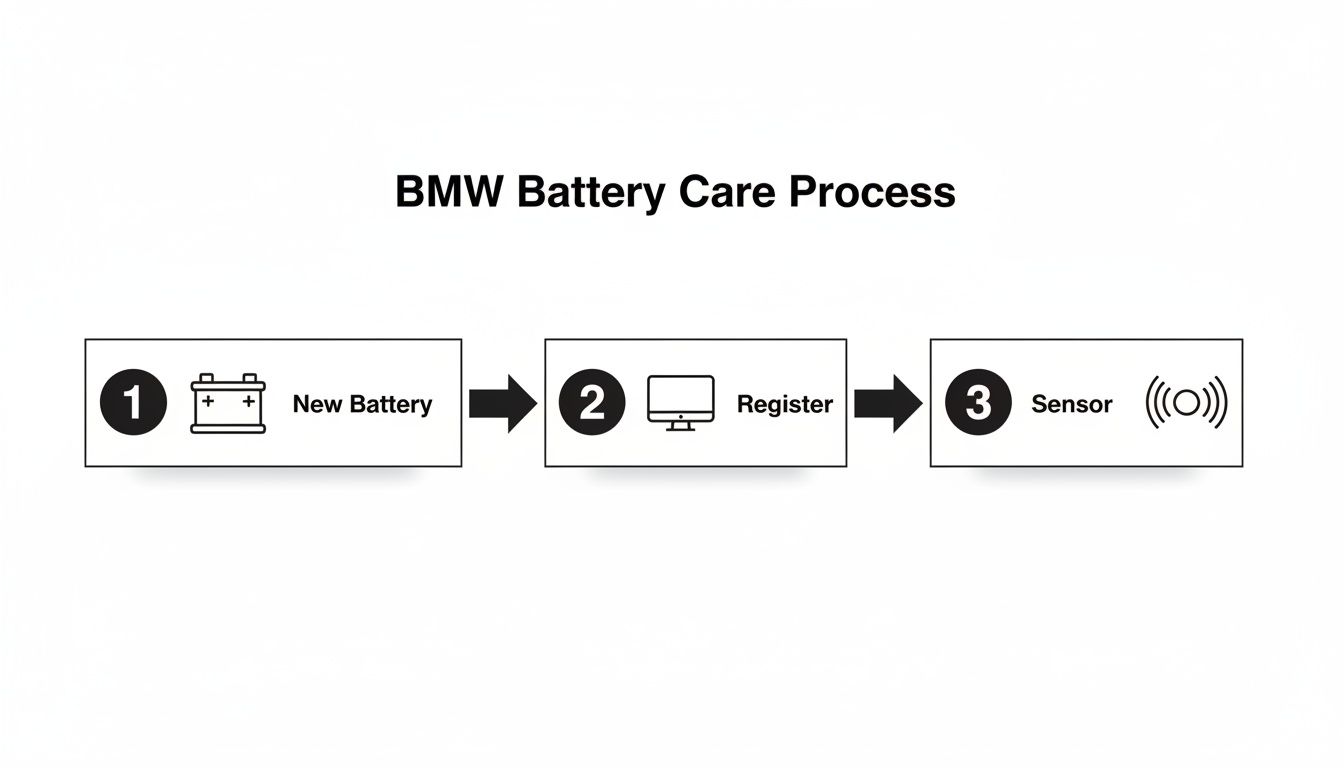 As this flowchart shows, just dropping in a new battery isn't enough. It has to be registered with the car's computer, and the Intelligent Battery Sensor (IBS) must be working correctly for the vehicle to manage its power properly.
Your BMW's advanced electrical system deserves expert care. If you have any concerns about your battery's health or need a professional test, the certified technicians at Habberstad BMW of Huntington are here to help. We have the specialized tools and knowledge to diagnose issues, properly register new batteries, and ensure your vehicle performs exactly as it was designed to. Visit us online to schedule your service appointment today.
Understanding Why Car Batteries Fail Prematurely
It’s a feeling every driver dreads: you turn the key, and all you get is silence. While batteries are wear-and-tear items, their lifespan isn’t set in stone. Many drivers assume a battery just "dies" one day out of the blue, but the truth is that failure is usually a gradual process caused by specific, often preventable, factors. Understanding what shortens a battery's life is the first real step toward avoiding a breakdown. For BMW drivers on Long Island, from Huntington to Oyster Bay, knowing how our local climate and driving patterns affect your vehicle is absolutely key to reliable performance.Key Factors That Reduce Battery Lifespan
Think of your car battery like a power bank for your phone. Certain actions drain it faster or damage its ability to hold a charge over time. The most common culprits are often just part of our daily routine. Here are the primary reasons a battery gives up sooner than it should:- Frequent Short Trips: If most of your drives are consistently under 20 minutes, especially in stop-and-go traffic around Commack, your alternator doesn't get enough time to fully recharge the battery. Starting the engine uses a huge burst of energy, and short trips mean the battery is always in a slight state of discharge, which is a recipe for a short life.
- Extreme Temperatures: Long Island weather is a major stressor. Summer heat speeds up the chemical reactions inside the battery, causing internal corrosion and making vital fluids evaporate. On the flip side, winter cold slows those same reactions, cutting the battery's available power and making it much harder to crank a cold engine.
- Parasitic Drain: Even when your car is off, modern vehicles draw a small amount of power to keep things like clocks, security alarms, and computer memory alive. But when aftermarket accessories or a faulty electrical component pulls too much power, it creates an excessive "parasitic drain" that can slowly kill the battery overnight.
- Vibration and Loose Connections: A battery that isn't bolted down tight can vibrate excessively as you drive, leading to physical damage to its internal plates. This constant shaking can cause short circuits and bring about a surprisingly quick end to your battery's life.
One reviewer on Yelp mentioned, "My last battery only made it two years. I finally realized I was only driving 5 minutes to the train station every day. My mechanic explained that wasn't enough to recharge it, and I basically killed it myself. Now I make sure to take the car for a longer drive on the weekends."To give you a quick roadmap for prevention, the table below breaks down these common killers and the simple actions you can take to fight back.
Common Causes of Premature Battery Failure and How to Prevent Them
Here's a quick look at what kills car batteries and the simple preventative measures you can take.| Common Cause | What It Does to Your Battery | Simple Preventative Action |
|---|---|---|
| Frequent Short Trips | Prevents the alternator from fully recharging the battery, leading to sulfation. | Combine errands into one longer trip; aim for at least one 20+ minute drive weekly. |
| Extreme Heat/Cold | Heat accelerates internal corrosion; cold reduces cranking power and slows chemical reactions. | Park in a garage or shaded area whenever possible. Consider a battery blanket in winter. |
| Parasitic Drains | Slowly depletes the battery's charge when the car is off, straining its capacity. | Unplug non-essential accessories like phone chargers and dash cams when not in use. |
| Excessive Vibration | Causes physical damage to internal plates and connections, leading to short circuits. | Periodically check that your battery is securely mounted in its tray. |
Smart Driving Habits That Boost Battery Health
How you handle your car day-to-day has a much bigger impact on its battery than you might think. It’s not about making some huge, inconvenient change to your routine. Instead, it’s about a few small, smart adjustments that stop the slow, steady drain that kills batteries prematurely. These simple habits can mean the difference between a reliable start every morning and an unexpected call for a jump. The number one battery killer is something we’re all guilty of: frequent short trips. Your engine needs a massive jolt of energy to start up, and it’s the alternator’s job to replenish that power while you’re driving. The catch? This recharging process takes time. If most of your drives are under 20 minutes, like a quick run to the store or dropping the kids at school, the alternator never really gets a chance to top off the battery. Do this enough, and you’ll get a condition called sulfation, where lead sulfate crystals build up and choke the battery's ability to hold a charge.Master Your Errands and Ditch the Short Trips
The best way to fight this is to think strategically about your driving. Instead of making five little trips throughout the day, try to group your errands into one longer drive. This gives your alternator the time it needs, usually 20 to 30 minutes at a steady speed, to do its job right. For instance, if you're in Commack and need to hit the post office, the bank, and the grocery store, plan a route that connects them all in one go. It’s a simple shift in planning that ensures your battery gets the sustained charge it needs to stay healthy.- Combine your trips: Plan your week to consolidate errands into one or two longer drives.
- Take the scenic route: If you have a short commute, occasionally take a longer way home to give the battery some extra charging time.
- Go for a weekly cruise: If you don't drive daily, make it a point to take your car for a solid 30-minute drive on the highway once a week.
Understanding Parasitic Drain
Even when your car is turned off, some systems are still sipping a tiny amount of power. This is perfectly normal and necessary for things like your car's clock, security system, and onboard computer memory. This low-level power draw is what we call parasitic drain. The trouble starts when that drain becomes excessive. Leaving accessories like a phone charger, GPS, or a dash cam plugged in can slowly suck the life out of your battery. Sometimes, a faulty electrical component, like a glove box light that won’t turn off, can create a serious drain overnight.A user on a popular BMW forum shared his experience: "My battery kept dying. We tested everything and found my new dash cam was pulling power even when the car was off. I started unplugging it, and the problem disappeared. It’s often the little things people overlook."To minimize this, get into the habit of unplugging all non-essential accessories before you leave your car. It’s a simple step that can prevent you from walking out to a dead battery.
The Importance of a Healthy Charge Cycle
Just like the battery in your phone, your car battery performs best when it's not constantly pushed to its limits. One of the most effective ways to extend its life is to avoid letting it drain completely. Deep discharges put a ton of stress on the battery's internal chemistry, causing damage that you can't undo. This isn’t just a theory; it's a well-documented principle. Data from the Battery Council International shows that batteries cycled between 50% and 80% charge can retain up to 30% more capacity over their lifespan compared to those that are regularly drained flat. You can see similar findings in Geotab's research on EV battery health, which applies directly to the lead-acid batteries in our cars. By taking longer drives and keeping that parasitic drain in check, you're not just recharging your battery. You're actively managing its charge cycle. This helps prevent the deep, damaging discharges, potentially adding months or even years to its service life. Here on Long Island, the weather isn't just tough on us. It's one of the biggest enemies of your car's battery. The humid, baking summers and the freezing winters we get from Huntington to Oyster Bay mean your car's electrical system is in a year-round battle. If you want your battery to last, you first have to understand what it's up against. Most drivers I talk to think the cold is the ultimate battery killer, but that’s only half the story. In reality, it's the summer heat that does the real, lasting damage, and a cold winter morning is often just the final straw.Why Summer Heat Is the Real Culprit
High temperatures are absolutely brutal on a battery's internal chemistry. Think of it like a tiny chemical plant under your hood. Once the temperature climbs over 90°F, the reactions inside speed up way too much. This isn't a good thing; it causes the battery's essential electrolyte fluid to evaporate faster and accelerates the corrosion of its internal lead plates. This constant, high-heat stress slowly chips away at the battery's health all summer long. Then, when that first truly cold day of winter arrives, the already-weakened battery just doesn't have enough muscle left to crank a cold engine. Suddenly, you're stranded. This is why we see a huge spike in battery failures in the winter, but the damage was really done months earlier. So, how can you fight back against the summer heat?- Park Smart: This one is simple but effective. Whenever possible, choose a garage or a shaded spot. Keeping your car out of direct, relentless sunlight can significantly lower the under-hood temperature, giving your battery a much-needed break from the stress.
- Keep It Clean: A dirty battery case can actually act like an insulator, trapping heat. A quick wipe-down with a damp cloth a few times during the summer helps it dissipate that heat more effectively.
Temperature control is a game-changer for extending car battery life, with extreme heat accelerating degradation by up to 40% faster annually. For the conventional 12V lead-acid batteries in BMWs, temperatures above 90°F speed up electrolyte evaporation and plate corrosion, potentially slashing life from a typical 48-60 months to as little as 24 months. Our own service records at Habberstad show a 25% spike in battery replacements from June through August over the past decade, confirming this is a real threat in Long Island's humid summers. You can discover more insights about these battery lifetime findings on fastmarkets.com.
Preparing Your Battery for Winter's Chill
While summer heat weakens a battery, winter cold is what truly tests its raw power. Frigid temperatures slow down the chemical reactions needed to generate electricity. The result? A battery in the cold has far less cranking power available, right when your engine needs it the most. A cold engine is much harder to start because the oil has thickened, creating more resistance for the moving parts. This forces your already-weakened battery to work overtime. At 32°F, a battery loses about 35% of its strength. Drop the temperature to 0°F, and it loses a staggering 60% of its power. This is exactly why a battery that worked perfectly on a mild fall day might suddenly give up the ghost on a freezing January morning.Practical Steps for Cold Weather Protection
You can absolutely give your battery a fighting chance against the Long Island winter with a few proactive measures. These steps are all about preserving its power and reducing the strain of those tough cold starts.- Use a Battery Blanket or Warmer: If your vehicle is parked outside in the severe cold, a battery blanket is a fantastic investment. It's essentially an insulated wrap that gently warms the battery, keeping its internal chemistry active and ready to deliver full power on demand.
- Consider a Block Heater: While they're more common in much colder climates, an engine block heater can be a lifesaver here, too. It warms the engine and its oil, which makes the engine much easier to turn over. This, in turn, dramatically reduces the demand on your battery during a cold start.
- Keep It Charged: A fully charged battery is much more resistant to freezing than one that's partially discharged. If you don't drive your car often during the winter, connecting a smart battery maintainer or a trickle charger will keep it topped off and healthy.
Taking Care of Your BMW’s Battery System
When you get behind the wheel of a BMW, you’re not just driving a car; you’re commanding a piece of high-performance engineering. That precision runs deep, especially into the electrical system, which is a world away from what you’d find in a typical daily driver. If you want to know how to extend your car battery’s life, understanding these unique systems is the first and most important step. Most modern BMWs don’t use traditional lead-acid batteries. Instead, they rely on Absorbent Glass Mat (AGM) batteries to handle the massive electrical loads from things like start-stop technology, sophisticated infotainment centers, and a small army of onboard computers. AGM batteries are built differently, using fiberglass mats to absorb the electrolyte. This makes them spill-proof, tougher against vibrations, and able to recharge faster to deliver the quick jolts of power modern tech demands. But this advanced technology comes with its own rulebook for maintenance and replacement. You can't just drop in a new battery and drive off. That simple mistake can trigger a cascade of electrical gremlins and kill your brand-new battery in record time.The Make-or-Break Step: Battery Registration
This is where so many owners and even general repair shops get it wrong. When a new battery goes into a BMW, you have to tell the car’s computer system about it. The process is called battery registration, and it's not some optional extra. It’s absolutely essential for the health of your car's entire electrical network. So, why is it such a big deal? Your BMW has a smart charging system that adjusts its strategy based on the battery's age and type. As a battery gets older, it naturally loses its ability to hold a full charge, so the alternator has to work harder to keep it topped up. If you install a fresh battery but skip the registration, the car’s computer has no idea. It still thinks the old, worn-out battery is in there and keeps using an aggressive charging profile designed for a failing unit. It will consistently overcharge your new battery. This can literally cook a new AGM battery in just a few months, turning your investment into a paperweight."Had a new battery put in my X5 at a generic shop and they didn't register it," reads one post on a Bimmer forum. "Six months later, it was dead. The BMW dealer explained that the car basically fried the new battery by overcharging it. A very expensive lesson to learn."This happens all the time and shows why specialized knowledge is key. Registering the battery resets the vehicle’s charging memory. It tells the system to use a charging profile made for a brand-new, healthy battery, letting it live out its full, intended lifespan.
The Brains of the Operation: The Intelligent Battery Sensor
Working hand-in-hand with the registration process is a small but mighty component called the Intelligent Battery Sensor (IBS). You’ll usually find this little piece of hardware clamped directly to the negative terminal of your battery. Think of it as the mission control for your battery management system. The IBS is constantly tracking a stream of critical data:- State of Charge (SoC): The battery's current juice level.
- State of Health (SoH): Its overall condition and ability to hold that charge.
- Voltage and Current: The flow of power moving in and out.
- Temperature: A huge factor in battery performance and longevity.
How to Test Your Battery and Store Your Car Properly
You don't need to be a professional mechanic to stay on top of your battery's health. In fact, taking a proactive approach is one of the best things you can do to extend its life, and it’s a lot easier than you might think. A few simple checks and some smart storage habits can save you from the headache of a car that just won't start. The quickest way to get a pulse on your battery is with a multimeter, an inexpensive tool you can grab at any auto parts store. It gives you a direct voltage reading, which is the clearest indicator of its charge level and overall condition.Checking Your Battery Voltage with a Multimeter
This is a five-minute job, tops. Make sure your engine has been off for at least a few hours to get an accurate "at rest" reading. Then, just connect the red probe of the multimeter to the positive (+) terminal and the black probe to the negative (-) terminal. What the numbers tell you:- 12.6V or higher: Perfect. Your battery is fully charged and happy.
- 12.4V: This means you're at about 75% charge. It's still in the healthy range, but a good drive would do it some good.
- 12.2V: Now you're down to 50% charge. This is your cue to take action.
- 12.0V or lower: Your battery is seriously discharged. At this point, you're risking sulfation, a chemical process that can cause permanent damage and shorten its lifespan.
Best Practices for Long-Term Car Storage
If you're parking your car for a while, maybe stowing a convertible for the winter or heading out on a long vacation, you can't just turn it off and walk away. A battery naturally loses its charge over time, even when the car isn't running. Proper storage is the key to making sure your car starts right up when you get back."I left my car at the airport for a three-week trip and came back to a completely dead battery," a driver posted on Reddit. "I had no idea it could drain that fast just sitting there. Now I use a battery maintainer religiously if I know I won't be driving for a while."It’s not just long trips, either. A Consumer Reports study of 50,000 vehicles found that batteries in cars driven less than 5,000 miles per year fail 40% sooner because of incomplete charging. This really drives home why long-term storage, or even just infrequent driving, needs a real strategy. You can dig deeper into how driving habits impact battery life on coltura.org.
Choosing the Right Tool for the Job
This is where a lot of people get mixed up. There’s a big difference between a standard battery charger and a smart battery maintainer (often called a trickle charger). A standard charger is great for reviving a dead battery, but leaving it connected can overcharge and fry it. For storage, what you really need is a smart battery maintainer. This device is much more sophisticated. It monitors your battery’s voltage and only delivers a slow, steady trickle of power when it’s needed to keep it at an optimal charge. It’s the perfect "set it and forget it" solution that prevents both undercharging and overcharging. For modern BMWs, keeping the battery healthy goes beyond just charging. The whole system is interconnected, and proper registration is a non-negotiable step.
As this flowchart shows, just dropping in a new battery isn't enough. It has to be registered with the car's computer, and the Intelligent Battery Sensor (IBS) must be working correctly for the vehicle to manage its power properly.
Answering Your Top Questions About Car Battery Life
Even after covering the basics, you probably still have a few questions floating around. That’s perfectly normal. When it’s about something as critical as your car's battery, you want to be sure you have all the facts. Let's tackle some of the most common questions we hear from drivers right here at the shop.How Long Should a Car Battery Last?
In a perfect world, a standard car battery should give you a solid three to five years of service. If you're driving a modern BMW with an AGM (Absorbent Glass Mat) battery, you can often expect a little more, typically in the four to six-year range. But those are just ballpark numbers. The real lifespan of your battery comes down to how you use it, the Long Island climate, and your maintenance habits. A string of short, five-minute drives or a brutal summer heatwave can definitely shorten its life.A verified review from a happy customer mentioned, "My last battery lasted almost six years. I always park in my garage, and my commute is about 30 minutes each way on the highway. I guess those little things really do add up."
Can a Completely Dead Battery Be Recharged?
Most of the time, yes. A completely dead battery can often be brought back to life. A jump-start will get the engine running, and from there, the alternator takes over the job of recharging. For a more complete and healthier charge, though, connecting it to a proper battery charger is always the better move. The bigger issue isn't just getting it recharged; it's the damage that happens when it goes flat. Each time a battery is fully drained, a process called sulfation occurs, where crystals build up and make it harder for the battery to hold a charge. You can usually get away with it once or twice, but if it becomes a regular thing, you're looking at a permanently weakened battery that just can't be trusted anymore.What’s the Difference Between a Trickle Charger and a Battery Maintainer?
This is a great question, and it's one we hear all the time. The difference is actually pretty important.- A trickle charger is simple. It pushes a slow, constant electrical current into the battery. It's good for slowly charging a battery but can be a problem if you leave it hooked up too long, as it can overcharge and cook the battery.
- A battery maintainer, often called a smart charger, is much more advanced. It monitors the battery’s voltage, charging only when needed. Once the battery is full, it shuts off and only kicks back in when the charge drops, keeping it perfectly topped off without any risk of overcharging.
Does Turning Off Accessories Before Shutting Off the Car Help?
Absolutely. Making this a habit is one of the easiest ways to help your battery. When you turn off the radio, A/C, and headlights before you kill the engine, you lighten the load on the battery for the next startup. A healthy battery can usually handle it, but this simple step reduces a lot of unnecessary strain. This is especially true as the battery gets older or on a cold winter morning when it's already struggling to deliver full power. Think of it as giving your battery a head start, you're making that initial, demanding job of cranking the engine just a little bit easier.Your BMW's advanced electrical system deserves expert care. If you have any concerns about your battery's health or need a professional test, the certified technicians at Habberstad BMW of Huntington are here to help. We have the specialized tools and knowledge to diagnose issues, properly register new batteries, and ensure your vehicle performs exactly as it was designed to. Visit us online to schedule your service appointment today.